The Six Ceremonies of Sustainability
Some weeks ago, on a beautiful Saturday morning, my wife and I were hanging out by the river when a white sedan came through our gate and parked in the area designated for events.
“What’s up?” my wife asked with an edge that suggested her real question: “What have you done to our day together?”
“I have no idea,” I said innocently, which wasn’t exactly true. I knew an event was upcoming: a water blessing that happens simultaneously on Mount Shasta, Mount Ashland, and here on the Rogue River at Ti’lomikh Falls. The ceremony has to do with an energetic “ley line” that is supposed to connect the three sacred sites—and was identified by the path of an osprey. But that ceremony was a week away. Or was it? Somebody had the wrong date. But who? I went to find out.
As I approached the sedan, I recognized Tim and Suzanne, two friends from salmon ceremonies we have held here in the past. Tim, ebullient as always, was bearing gifts: a wooden box that looked like a book, inside of which was an acorn-shaped carving made of mother-of-pearl and a tiny baby basket made of twigs. These were beautiful pieces that obviously took time to make, and I was moved. Meanwhile, Tim was embarrassed, wondering if he had the wrong date. Then more cars arrived, and so did an osprey, which made a spectacular dive into the river. So, we laughed—and I realized my day had changed.
It also dawned on me that I had screwed up more than just my calendar. My understanding of the local Indigenous ceremonies—and thus a major part of my quest to become an earth-indigenous elder—was wrong. Again! I felt akin to Mel Brooks in his classic comedy The History of the World: Part 1, when he plays Moses coming down from Mount Sinai with three stone tablets and 15 commandments. And then … Oops! Two tablets and 10 commandments!
My problem was worse. I have spent years working with huge pieces of galvanized steel pipe, a helicopter cargo net, and a large boulder to create a sculpture representing the four key ceremonies of the Takelma community that lasted here for thousands of years. But then I realized that such long-term sustainability required five key ceremonies. And now the water blessing made six. I had dismissed the water blessing as well-intentioned nonsense, but it may be the most important of them all. Damn!
Let’s Back Up
Twenty-five years ago, when I found my land along Ti’lomikh Falls while kayaking, I didn’t give a thought to its Indigenous history. The Takelma left no trace that I could see. When I learned that my land had once been a large village, I judged their Indigenous lifestyle as impoverished because burials excavated downstream that were hundreds and thousands of years old typically contained the same simple elements: a tobacco pipe, an obsidian blade, and some beads. To my way of thinking, these poor people made no progress.
In 2006, when the famed Takelma elder Grandma Agnes Baker Pilgrim came to my home and we found a sacred Takelma site called the Story Chair at the base of the falls and restarted the ancient salmon ceremony, it seemed just another fine adventure. I didn’t think I had anything significant to learn from such ancient people. I was wrong.
What’s inarguably true is that the Takelma living here had a gentler climate and a much more plentiful supply of local, organic, and healthy food. For thousands of years, the village people hunted and gathered and performed the basic maintenance of paradise: setting fires to clear brush for deer and cleaning spawning gravels to help the salmon. The only plant the Takelma cultivated was tobacco, used for ceremonies. They slept under the stars when the weather was good and in plank houses dug into the earth when it got cold.
The village had no fortifications, walls, jails, pyramids, churches, mortgages, daycare centers, or senior communities. The centerpiece was the Story Chair, a natural stone seat near the base of the falls that happens to be the most spectacular and comfortable place to sit with a dipnet and scoop up salmon, which were ritually shared among the local tribes so that no one went hungry. Gold lay in chunks on the ground, and they ignored it. Wealth was ceremonially given away. Huge dances mixed up the gene pool. The Takelma didn’t have a written language; instead, they told stories. The “Story Chair” suggests that fundamental wisdom was rooted in the natural world and transmitted viscerally through actions in ceremonies.
Gradually my judgment about these “poor people who made no progress” transformed into a question: How did the Takelma live here for so long without screwing it up? I narrowed down their myriad ceremonies to what seemed the four essentials of a sustainable society and set out to tell that story in a large public sculpture to commemorate the 250th anniversary of our Declaration of Independence. I figure we need a better story, and maybe that means looking back to the first people to come to America.
The Four Ceremonies
The first ceremony is the tobacco ceremony, symbolized in my sculpture by a giant steel tobacco pipe. Nicotine helps people focus, and tobacco smoke carries one’s words to the Creator. So the ceremony is a perfect prelude to serious conversations and negotiations: a pathway to self-evident truths that stand the test of time.
The second ceremony is the salmon ceremony, symbolized by a giant steel dipnet frame and the cargo net. Salmon were caught gently in a dipnet from the Story Chair and shared sacramentally among the local tribes, both to manage the food supply and to ensure everyone has enough to eat. To my mind, the ceremony represents the original Right to Life.
The third ceremony here is the vision quest, symbolized by a boulder naturally eroded by the river into a comfortable seat. The vision quest is a solo ceremony: sitting alone in nature to listen for one’s own story. The Right to Liberty.
The fourth ceremony is the potlatch, a give-away ceremony that ensures that wealth does not accumulate and equality is maintained. To represent the potlatch, I created a huge swing set to represent life always swinging into balance—a balance that allows everyone the Pursuit of Happiness.
The Fifth Ceremony
Those four Takelma ceremonies are foundational to our Declaration of Independence, and the promise of Life, Liberty and the Pursuit of Happiness is the very best of America. But as I began installing my sculpture last year, somebody stole the cargo net out of the frame. It was heartbreaking, but it also seemed appropriate at a time when our social safety net is being shredded, our summers are so hot that fire season can be terrifying, and we can’t seem to solve even immediate problems because everyone is at each other’s throats. That’s when I realized that long-term sustainability requires a fifth major ceremony that took place at Ti’lomikh Falls, a ceremony that deals both spiritually and physiologically with the fires and fervors inside people—and provides an ultimate source for Jefferson’s “separation of church and state.”
The village of Ti’lomikh didn’t have any churches and hardly any state. What everybody did instead was sweat! The semi-subterranean structures the men lived in were also used for the purification ritual known as the sweat lodge; the women had their own regular sweats in separate lodges. The Takelma would heat stones in a fire before bringing them into the lodge and pouring water over them to create steam. A few hot rounds of singing and prayer, punctuated by jumping into the river, drains away anger and leaves people blissed out and able to get along better with or without divine intervention. My sculpture garden needed a lodge.
The Water Blessing Returns
I have had a difficult relationship with water blessings. My first, which I don’t remember, was my baptism into the Catholic church. What I do remember is dipping my fingers weekly into holy water until I was old enough to give up Catholicism. Decades later, in 2004, I began to think seriously about water blessings when Masaru Emoto published a huge bestseller, The Hidden Messages in Water, with photographs purporting to show that thoughts can dramatically change the structure of ice crystals. I knew several scientists involved in prayer research and so I was immediately skeptical of Emoto’s work: The photos appeared too dramatic to be real.
As editor of Spirituality & Health at the time, I reached out to Emoto for details—and got no response. I then asked veteran science writer Jill Neimark to check him out and learned that Emoto bought his Ph.D. for $500 and published a scientific paper as Masaru Emoto, M.D., which is fraud. Neimark also reported that you can photograph any message you want in ice crystals by adjusting the camera angle. Nevertheless, Emoto’s message spread, and even Grandma Aggie began quoting his findings in her Takelma blessings. Then she and another friend started a water blessing on Mount Ashland, and an errant osprey eventually brought it here. These ceremonies were heartfelt, but they made no sense to me. Why bless water?
Nevertheless, I found myself beside a fire and a glass bowl filled with river water while a woman named Echo sang in Takelma, a word that means people of the river. Then we waded into the Takelma’s river to return the blessed water and float some cedar needles carrying our intentions out into the current. We watched our tiny needles sail off toward the mighty falls and the Story Chair and then turned away.
Then, as we walked back up the bank, Echo chuckled and said something that I realized in retrospect was an Indigenous response to Descartes’ famed declaration, “I think, therefore I am”; to the chicken-vs.-egg assertion that physicality emerged from consciousness rather than consciousness being a product of the brain; and to Emoto’s messages in water. Echo’s simple, wise, and ultimately obvious observation is why water blessings are a key to long-term sustainability.
“It’s kind of silly to think we bless the water,” she said. “We come here to be blessed by the water.”
This article appeared in the September/October 2025 of Spirituality & Health: A Unity Publication®. Subscribe now.
About the Author
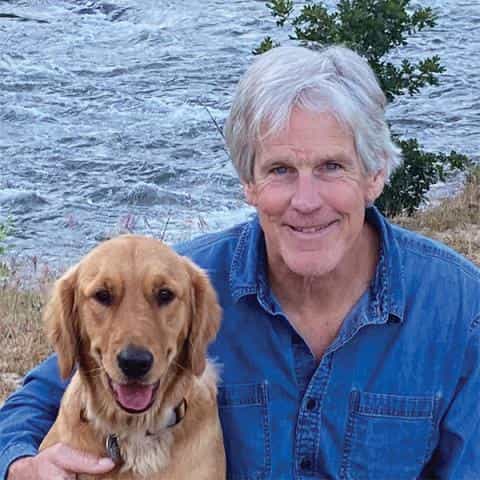
Stephen Kiesling is a founding editor of Spirituality & Health magazine and is now editor at large. A lifelong journalist, he was a Scholar of the House in philosophy at Yale University and an Olympic oarsman. His passion is building parks and playgrounds. His current project is a whitewater park and sculpture garden at Ti’lomikh Falls on the Rogue River in Oregon. Visit goldhillwhitewater.org.
More
 Article
The Natural History of Our American Revolution
Stephen Kiesling explores how Takelma ceremonies, truth-telling, and harmony with nature shaped our nation’s principles and what we can learn from them today.
 Article
The Virtual Salmon Ceremony
Join Stephen Kiesling on a journey through the Virtual Salmon Ceremony, where storytelling and sacred traditions aim to revive the Rogue River salmon.
 Article
Diverse Leaders Bring Fresh Vision to the UWH Board of Directors
Meet Unity World Headquarters' new board leadership: diverse voices guiding inclusion, community outreach, and timeless teachings for all.
 Article
Our Widely Distributed Intelligence
From MIT’s Cog and Kismet to a friendly robot at CES, discover how embodied intelligence challenges our notions of soul, consciousness, and human connection.