Our Widely Distributed Intelligence
Last January I took my annual pilgrimage to CES, the consumer electronics show in Las Vegas, and I stopped at a booth that showed off a shiny new humanoid robot. It was the size of a small adult, like a jockey or a coxswain, and was designed with a jaunty, embodied friendliness. A promotional video announced that this new robot would “provide companionship that anticipates your needs and makes life easier and adapts to your lifestyle.” Meanwhile, the robot noticed me and walked over to shake my hand.
I didn’t catch the robot’s name because I was busy taking a picture of its hand in mine, which was rude. I treated the robot as a machine, an object, rather than as the rising star it was made out to be. Meanwhile, in the time it took to shake my hand, the robot read the media pass around my neck and could have read everything I’ve published online. With a few prompts, it could have sifted through my Facebook friends, LinkedIn connections, and Google searches to figure out how to anticipate my needs and desires. If I had stayed a bit longer, I wouldn’t be writing this now against a deadline because my companion would have drafted the piece months ago.
But it was only after the robot left me and then turned to wave goodbye that I finally noticed something disconcerting. This robot had no face. The “head” was a glowing, turquoise-colored ring that sat upright on its neck so that I could see right through it. The traditional space for a human brain was empty—and the missing brain brought me back to the first time I shook hands with a robot, when my ideas about human consciousness and machines began to fall apart.
S&H Joins the MIT AI Lab
It was 1998, the year we officially launched Spirituality & Health, and the beginning of a collaboration between this magazine and the MIT Artificial Intelligence Lab. The key to our collaboration was Anne Foerst, Ph.D., a Lutheran theologian and computer scientist who worked at both the MIT AI Lab and the Harvard Divinity School. We met at a conference called “Science and the Spiritual Quest” in Berkeley, where Foerst was on stage wondering when it would be appropriate to baptize two new baby robots, Cog and Kismet. People chuckled, but she wasn’t joking. Soon she was writing for the magazine, and readers were participating in AI experiments on our website.
Foerst grew up in Germany, where a childhood illness and many operations caused her to anguish over a huge question: Is her body herself, or is it a vessel to house her real self? Her Lutheran religion offers an answer: Her faith calls for the resurrection of the body because body and soul are inseparable—which is very different from having a separate immortal soul or being a part of universal consciousness. Nevertheless, the question of body and soul nagged at her as Foerst became both a computer whiz and a theologian—especially as she began contemplating the theological implications of artificial intelligence and building robots. In her doctoral thesis, she set out to prove that building a machine with human-like intelligence is impossible, but her research changed her mind. AI was coming, and so was a big question: If you build a machine that learns and behaves like a human, are you at some point building a soul?
Foerst then joined the MIT AI Lab because the director, Rodney Brooks, Ph.D., was making remarkable leaps in robotics. Brooks had realized that he couldn’t build a computer brain that was powerful enough to enable a robot to walk or jump like a human and be small enough to fit inside a robot. The technology for such “top-down” processing didn’t exist. What Brooks did instead was put small, independent brains at every joint of the robot body. Working from the “bottom up”—with intelligence distributed throughout the body—Brooks’ robots learned to walk and jump and do all kinds of other things.
“The developmental evidence from babies and now from robots is that our sense of ‘I’ emerges out of our embodied intelligence exactly because we have places to go and things to do.”
Cog, the first robot I shook hands with, didn’t have much of a head, and it didn’t have a program to shake hands. Instead, Cog was a body that learned to shake hands much like a human child—by trial and error. Meanwhile, another robot named Kismet was almost all head—and learned to interact “emotionally” with humans using a wide range of facial expressions. Nobody pretended these robots were self-conscious or were even trying to be. But newborn babies are not self-conscious either. Even 25 years ago, the actions of these baby robots could appear disconcertingly human.
For me, this exploration of embodied intelligence was oddly personal. I was raised Catholic, but my spiritual practice is rowing, exploring the limits of the body, and I had just stroked the U.S. eight that beat the Russians to win the ’98 Nike World Masters Games. Our local newspaper ran the story, and then a group of high school girls asked me to coach their new crew. At that time, I had rowed for more than 20 years, but I had never coached, and it quickly dawned on me that my Olympian skillset was not conscious—and perhaps not even in my head.
Over years of rowing with great coaches and athletes, I had tuned mechanoreceptors in my muscles, ligaments, and tendons to sense the water through my oar and react fluidly. To become a coach, however, I had to go back and listen to other coaches and observe myself to figure out what I did so well. And so I wondered, was I a rowing machine? The question was weird and humbling and caused me to wonder about how else intelligence might be distributed in the body.
Psychologist Robert Thayer, Ph.D., provided another clue to distributed intelligence in his book The Origin of Everyday Moods. Thayer argues that what we call “moods” derive from how we interpret energy states in the body. The root of happiness is a state of high energy and low tension—“calm energy”—while the root of depression is a state of low energy and high tension—“tense-tired.” From studies using thousands of undergraduates over decades, Thayer established that the most reliable way to raise energy, lower tension, and improve your mood is by taking a 10-minute walk. The short walk is better than eating a candy bar or calling a friend or meditating or anything else. In other words, Thayer’s experiments established that the most reliable path to happiness is not in your head. It’s embodied.
Perhaps the most glaring evidence of this body intelligence comes from antidepressants. While the drugs make many people feel better, nobody really knows why, and many of the theories remain contradictory. What caught my attention were the common side effects of antidepressants—emotional blunting, gastric problems, and sexual dysfunction—and the realization that these may not be “side effects” but primary effects on different “brains.”
As you may have learned in biology class, the first “brain” to develop in a fetus is not in the head; instead, it is a cluster of neurons in the heart. Humans also have large clusters of neurons in the gut—the enteric nervous system, or “gut brain”—and another “brain” in the reproductive organs. Eastern healing traditions, which typically didn’t practice dissection, identified these brains as energy centers, or chakras, and healers attuned to energy systems figured out how to improve both happiness and health by bringing the chakras into balance. Western neuroscientists, however, concentrated on the big brain in our skull and have treated other brains mostly as poetic metaphors.
But consider oxytocin, the love or bonding hormone. Both the “head brain” (the hypothalamus) and the “heart brain” produce oxytocin—so it shouldn’t require a poetic license to declare that the emotional blunting of antidepressants has to do with a direct effect that antidepressants have on the heart. The same must be true with gut problems and sexual problems as well. The body has more than one brain impacted by brain-altering pharmaceuticals. You probably already knew that in your heart, your gut, and that root-chakra brain. Each one can take on a life of its own.
The Curse of Interesting Times
Brain surgeon and S&H contributor Allan Hamilton, M.D., estimates that our conscious processing in the brain—that wondrous sense of “I”—is just a tiny fraction of the unconscious processing required to run all the intricate systems of the body (like a thimbleful of water in relation to Niagara Falls).
To that I’ll add that I think the tiny thimbleful is a master of infinite illusion. For example, if you inhale a miniscule amount of Sonoran Desert toad venom—known as 5-Me0-DMT—bodily reality can evaporate, and you may experience your own “I” floating in infinite space. It can be amazing bliss—nowhere to go and nothing to do—for about 10 minutes before you come back to your body. For my friend Robert, the experience confirmed his belief that he is a spiritual being that drops into various bodies and lifetimes to gain experience, and that belief in turn allows him not to worry about stuff like climate change or AI bots taking over. But I think the developmental evidence from babies and now from robots is that our sense of “I” emerges out of our embodied intelligence exactly because we have places to go and things to do. There is a creature called a sea squirt that makes the opposite choice—it swims around for a while, and then it attaches itself to a rock, devours its brain, and becomes a plant.
Earlier this year, a woman in Georgia without measurable self-consciousness was kept alive by machines just long enough to give birth to a baby—a fact too weird to grok. That’s why I’m heading back to CES in January. I’m sure my companion will anticipate my questions—if I can just remember its name.
This article appeared in the November/December 2025 issue of Spirituality & Health®: A Unity Publication. Subscribe now.

About the Author
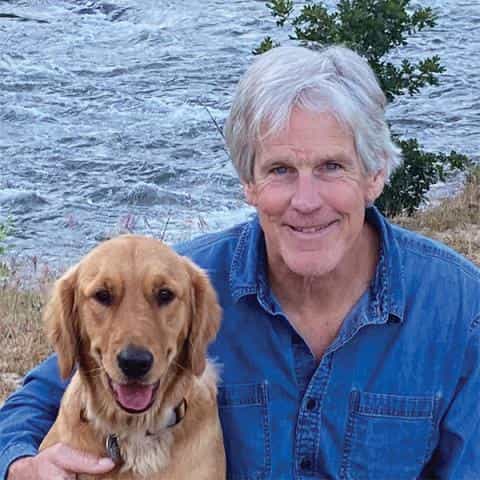
Stephen Kiesling is a founding editor of Spirituality & Health magazine and is now editor at large. A lifelong journalist, he was a Scholar of the House in philosophy at Yale University and an Olympic oarsman. His passion is building parks and playgrounds. His current project is a whitewater park and sculpture garden at Ti’lomikh Falls on the Rogue River in Oregon. Visit goldhillwhitewater.org.


More
 Article
The Six Ceremonies of Sustainability
A mix-up leads to a revelation about Indigenous ceremonies at Ti’lomikh Falls, uncovering the vital role of water blessings in sustainable living.
 Article
One World, One Heart: Finding Solace in Senseless Loss
Navigate tragedy with hope. Transform pain through divine love, and explore articles, booklets, and other resources.
 Article
Sonia Choquette on Trusting Your Vibes
Sonia Choquette explains how intuition—once dismissed as superstition—is now essential amid global shifts. Learn to tune into your inner GPS and live aligned.
 Article
Spirituality & Health: A Unity Publication Wins Top Honors at the 2025 FOLIO: Awards
Celebrating its full first year, Spirituality & Health: A Unity Publication clinched top honors at the 2025 FOLIO: Awards.