The Natural History of Our American Revolution
A few months ago, I walked downstream to Ti’lomikh Falls on the Rogue River in Oregon and felt a surge of happiness. A family was playing on my new steel and stone sculpture, which I finished last year (see “Six Ceremonies of Sustainability” in the September/October 2025 issue). The dad was helping his son climb into the salmon dipnet, which represents the Takelma salmon ceremony. The mom and daughter were together on the swing, which represents the potlatch or giveaway ceremony. My golden retriever Milli posed for a treat on the vision quest boulder. Seeing all this, I didn’t need to burn sacred tobacco in the giant pipe sculpture to carry my words to the Creator. My prayers were reaching their destination already.
Then I saw the dad reading my sign that explains the sculpture, and a still-fresh memory made me wince. Solid evidence shows that the four ceremonies took place here, and Takelma oral tradition can be traced back possibly to the first peoples in America. My sign asserted that these ancient ceremonies are the source for the “Life, Liberty and the Pursuit of Happiness” in the Preamble to our Declaration of Independence. But when I told my theory to Akhil Reed Amar, J.D., a celebrated professor of constitutional law at Yale Law School, he listened because it was our college reunion. Then he cut me off.
“The Enlightenment ideas of the Declaration of Independence came from men like John Locke,” he said. “I’m a professional historian. This is woke bullshit.”
Those words hurt, and then I couldn’t help but wonder: Is my sculpture monumentally wrong?
A Very Personal Quest
What pushed me into this American Revolutionary story was 9/11. Trinity Church Wall Street in New York City had celebrated its 300th anniversary in 1997 in part by launching Spirituality & Health magazine, and our goal was to explore the world’s spiritual practices in search of common ground. It was oddly appropriate, therefore, that just four years later, Trinity’s chapel, The Chapel of St. Paul’s, became the haven for firefighters working at Ground Zero after the terrorist attacks struck the World Trade Center.
Because many of the magazine staff became volunteers at St. Paul’s, the rector offered me a tour of the devastation when I visited a few weeks after the attacks. Afterward, I was overwhelmed by grief and shock and something worse because when I spoke with men amidst the wreckage who had rushed into burning buildings, they treated me like clergy. Our insurance required us to wear hardhats, and the one the rector had given me to wear said “CLERGY.”
I then sat down in George Washington’s pew, where he prayed before America’s first presidential inauguration. This was not a feel-good moment. I felt ashamed for wearing the misleading hardhat and for my inability to do anything useful for these first responders. Then I looked down at my black shoes coated in white ash and realized the white ash was, in part, the remains of people.
I wasn’t angry. I didn’t want revenge. I was asking myself, Why am I here? Gradually, grief and shock and shame crystallized into a question and a quest: Given Americans’ high ideals, why do so many people around the world hate us so much?
When I got back to Oregon, I did something that at first seemed unrelated. I hired a Native American storyteller to teach me about my newly purchased land on the Rogue River, and that turned into a search for the Story Chair—the centerpiece of the Takelma salmon ceremony, a ritual of sharing their principal food with other tribes so that no one went hungry. It took a few years, but then the oldest living member of the Takelma people, Grandma Agnes Baker Pilgrim, came to my home with a photograph of her father on the Story Chair taken in 1933 by a linguist from the Smithsonian. I used the photo to locate the chair at the base of the waterfall, and the ceremony came home.
I have come to believe that the Story Chair is an original symbol of the Native American obligation to share food: The Right to Life. That natural right is why the Wampanoags didn’t let the Pilgrims starve in 1621, and perhaps even why America came to be. But I couldn’t establish the connection at the time.
What Woke America
On the day I saw the family playing in my sculpture park—a beautiful day now clouded by self-doubt—I did what I typically do: I pushed harder into my next project, a sculpture based on a Takelma pit house that once dotted both sides of the river. What baffled me is why the Takelma sank their houses deep into the ground, lined the walls with cedar planks, lashed everything together with hemp rope, and crammed the interior with dried salmon. The village had no forts or walls or churches. Why build bunkers in paradise?
And then a thought struck me … OMG! Earthquakes!
I suddenly knew something Thomas Jefferson couldn’t have known: The event that first made “the Laws of Nature and Nature’s God self-evident” was a natural catastrophe that last occurred in 1700. In the 1980s, scientists discovered that about every 300 to 500 years, the Cascadia subduction zone—a fault that stretches from Northern California to Vancouver Island—breaks loose in an earthquake registering a magnitude of 9 and above. The tectonic plates deep underwater slip up to 50 feet, historically causing the coastline to drop suddenly, triggering a tsunami. Geologists say this tsunami can be as high as 100 feet, which could reach 10 miles inland—or even farther. New research suggests that about half the time, within hours of the Cascadia quake, California’s San Andreas fault breaks loose too.
We also know something else: The first Americans came by boat from Asia more than 20,000 years ago and settled on the coast of the Pacific Northwest. Now—thousands of years of earthquake/tsunami cycles later—those first settlements are miles out to sea, hundreds of feet below the surface.
Imagine the scene: 600 miles of coastal destruction as horrifying to these Native Americans as 9/11 was to us—every 300 to 500 years. As survivors migrated up rivers like salmon, dug their houses into the ground, and stuffed them with food, certain truths became self-evident: Their old gods from Asia were powerless before Nature’s God. Every living thing was equal: two-legged, four-legged, salmon, and cedar. What mattered for survival was relations. All your relations. Such hard-won lessons became too important for storytelling. They had to be drilled in by tobacco and salmon ceremonies, vision quests and potlatches.
Speak the truth because it’s all you have. Bless and share your food because every creature has the right to life. Listen to nature because she is the source of wisdom and liberty. Prove your value with gifts that bring happiness. And look ahead seven generations so your descendants won’t be knocked flat and swept away.
The Seventh Generation principle, that decisions made today will have an impact on the next seven generations, was written much later into the Great Law of the Haudenosaunee (the Iroquois Confederacy) and with it the earthquake warning lost its punchline. Nowadays, Seventh Generation is best known as a brand of eco soap and toilet paper, which may explain why Native Americans were not eager to write down stuff that matters.
How Europeans Learned From America
In 1608, Father Pierre Biard, a French priest assigned to convert the Mi’kmaq people to Christianity, reported:
[The Mi’kmaq] consider themselves better than the French: “For,” they say, “you are always fighting and quarreling among yourselves; we live peaceably. You are envious and are all the time slandering each other; you are thieves and deceivers; you are covetous, and neither generous nor kind; as for us, if we have a morsel of bread we share it with our neighbors.”
In 1621, the Pilgrims felt no obligation to share their first harvest with the Wampanoags, who had saved their lives. Instead, the Pilgrims fired muskets in celebration, and the Wampanoags came running to help. The Wampanoags brought venison, and Thanksgiving was born.
In 1689, English philosopher John Locke “discovered” the natural rights: Life, Liberty and the Pursuit of Property.
In 1753, Benjamin Franklin proposed a confederation of 13 colonies modeled after the Six Nations of the Haudenosaunee, a Native American democracy that had flourished for centuries.
In 1773, Boston Tea Partiers demonstrated that they were not thieves by dressing like Native Americans.
In 1776, Thomas Jefferson, the heir to a tobacco plantation who collected Native American peace pipes and later featured them in his “Peace Medals,” captured the moral high ground with the words: “We hold these truths to be self-evident …”—which could easily have been a reference to the tobacco ceremony, where the promise to speak the truth is held in one’s hand.
The Declaration of Independence united an army of free men and women, indentured servants, enslaved persons, and Native Americans to beat the British. But these were written words—not spiritual practices—and the British version of the Enlightenment concealed a voracious appetite for property. In 1792, Jefferson asserted the Doctrine of Discovery as a tenet of international law, serving as the legal justification for the United States to claim property occupied by Indigenous peoples. In 1856, the Doctrine of Discovery empowered a militia of gold miners, backed by the U.S. Army, to kill the Takelma, take their property, and march the survivors away to reservations.
Why Did Grandma Come Home?
Agnes Pilgrim learned about the Rogue River Wars from family members who survived. She grew up without basic rights and wanted justice, and yet she embodied kindness. In 1970—270 years after the last Cascadia earthquake—she had a spiritual awakening and returned to her home river, the Rogue. As the 300th anniversary of that last quake approached, she reenacted the salmon ceremony on a tributary and then brought it home to Ti’lomikh Falls in 2007. She never mentioned the quake, so the timing of her return was probably a coincidence. What’s inexplicable is that she claimed her people had been in America for 22,000 years. After she died in 2019, archaeologists found human footprints in New Mexico and dated them to between 21,000 and 23,000 years old. How did she know? And did she somehow carry a warning—an unconscious ancestral memory of devastation—in her bones, passed down through generations of survivors?
When the earthquake does hit next, scientists predict that brick school buildings in Portland will collapse minutes before San Francisco is set ablaze. Damage estimates are in the trillions of dollars. My worry is that we’ve strayed so far from the practices that birthed America that this disaster could tear us apart. I also believe the solution is written into our Declaration of Independence: Knowing what it really means for the first time.
This article appeared in the July/August 2026 issue of Spirituality & Health: A Unity Publication®. Subscribe now.
Acerca del autor
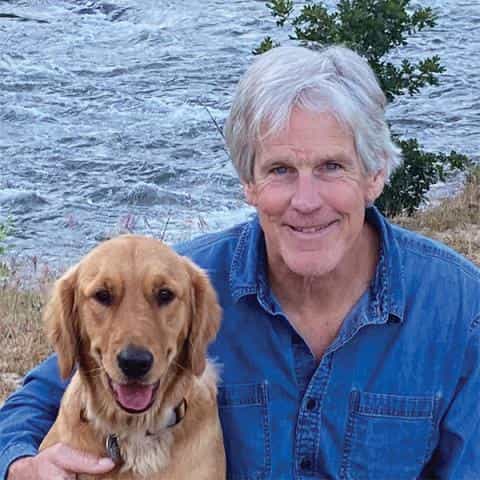
Stephen Kiesling is a founding editor of Spirituality & Health magazine and is now editor at large. A lifelong journalist, he was a Scholar of the House in philosophy at Yale University and an Olympic oarsman. His passion is building parks and playgrounds. His current project is a whitewater park and sculpture garden at Ti’lomikh Falls on the Rogue River in Oregon. Visit goldhillwhitewater.org.
Más como este
 Artículo
The Six Ceremonies of Sustainability
A mix-up leads to a revelation about Indigenous ceremonies at Ti’lomikh Falls, uncovering the vital role of water blessings in sustainable living.
 Artículo
The Virtual Salmon Ceremony
Join Stephen Kiesling on a journey through the Virtual Salmon Ceremony, where storytelling and sacred traditions aim to revive the Rogue River salmon.
 Artículo
Diverse Leaders Bring Fresh Vision to the UWH Board of Directors
Meet Unity World Headquarters' new board leadership: diverse voices guiding inclusion, community outreach, and timeless teachings for all.
 Artículo
One World, One Heart: Finding Solace in Senseless Loss
Navigate tragedy with hope. Transform pain through divine love, and explore articles, booklets, and other resources.