Sacred Journeys Rewilding in South Africa
Last October, at a trade show for the retreat industry, I heard about a new safari retreat in South Africa—Sashwa: River of Stars—that made me curious. As time went on, the concept behind the retreat—fostering yoga consciousness in an environment that includes large predatory animals—gnawed at me. Then I learned that if I wanted to satisfy my now insatiable curiosity, I just had to get myself to Johannesburg and then board a 45-minute flight to Hoedspruit, where a visionary named Peter Eastwood would drive me to the banks of the Oliphants River, a tributary of Rudyard Kipling’s famed “great green greasy Limpopo River, all set about with fever-trees.” The Limpopo is where the nosy Elephant’s Child wondered about what the crocodile had for dinner, and thus—after a bit of a misadventure—the elephant got its trunk. The tributary is where, O my Best Beloved, the question of what the crocodile might have for breakfast transformed my own consciousness. Seriously.
The Making of a Visionary
Eastwood, 66, started working at age 15 in a New Zealand wool factory where his job was to make sure the machines were ready before the main shift arrived. He learned to spot problems and solve them fast. Meanwhile, he devoured safari novels and fell in love with South Africa, so he traveled there expecting to find a job in an industry he loved in a land he loved. What he found, instead, was apartheid, so he left.
“I wasn’t going to work in a factory that ran on slavery,” he told me.
Back in New Zealand, the wool industry collapsed, and Eastwood realized there was a good business in selling home brewing equipment. He then proved to be really good at empowering people all over the world to help him build a huge home-brewing business, which he sold in 2018, planning to retire. He started his retirement by spending six months on a driving safari with his grown kids and his girlfriend and covered about 25,000 kilometers and almost every country in Africa. Along the way, Eastwood decided to do something to help solve the issue of game poaching and the residual problems of apartheid.
The Vision
Eastwood bought a riverfront lodge situated on a 2,000-acre private reserve open to the famed Kruger National Park. He then transformed the place into a vegan-yoga-meditation-LGBTQIA+-friendly retreat where as many as 16 guests at a time experience not only the consciousness-raising of a yoga retreat but also conscious rewilding through daily walks and drives among the grand animals that make Kruger the Yellowstone of South Africa. Meanwhile, the proceeds go to fund Koru Camp, where up to 24 Black kids who might otherwise never get to venture into Kruger get their own rewilding experience.
Eastwood has bet that the safari experiences for both sets of guests will alter the trajectory of their lives for the better. The greatest impact will be on the kids, who will grow up to love the parks and to find honest work there—rather than the poverty and alienation that leads to poaching. Both safari camps are now open to test his concept and hopefully be replicated by other philanthropists across Africa.
My Adventure Begins
When I got off the Airlink jet and walked through the tiny airport at Hoedspruit, Eastwood was right outside the door. He grabbed my bag and tossed it into the compartment of his highly customized Toyota Land Cruiser, a safari machine seemingly powerful enough to climb straight up a baobab. We set off down the two-lane highway and he pointed out a family of baboons hanging out along a wire game fence perhaps eight feet tall.
We then had a detour due to a terrible taxi accident, but pretty soon I showed my passport to an official at a gate in the long fence, and we entered an area of private game reserves around Kruger National Park. For the next 45 minutes, we didn’t see another car, but we had to stop for a family of giraffes to move out of the road, and then we stopped to admire some zebras, and then some impalas, and then a warthog and a couple dozen elephants. These animals were part of Eastwood’s commute, but new to me. Meanwhile, he told me about fences and the accident we had just gone around.
The magic of Kruger is the lack of fences in an area twice the size of Yellowstone and as big as New Jersey. But to create the park and the private reserves to protect animals, the Indigenous peoples were fenced out. Nowadays, taking a self-driving tour through the national park is not expensive for an American tourist but is out of reach for people living just outside the fence. Many can’t afford to rent cars, let alone own one. To get to work, locals typically wait for taxi-vans to fill up with 13 riders. The terrible accident that had created our detour had taken 13 lives, and many more might now go hungry. The locals desperately need better jobs, and the larger world needs to help if the community and its animals are to be protected.
Eastwood’s 2,000-acre reserve has just a small sign and no fences to mark the property. Instead, the land is marked by single-lane “cut-lines” also used for safari drives. Well inside the reserve is a 20-acre riverfront resort that has an electrified fence to keep big beasts outside. We drove in through an automatic gate and were greeted by the spa staff, who had prepared a delightful handwashing ceremony using sand from the river mixed with essential oils, an exfoliating cleanse that immediately connected me to the local earth. Then I was shown to a villa overlooking the mud-brown river. At the edge of my patio were fever trees that hosted a couple monkeys. I asked about kayaking the river, which elicited a smile from my host, who gestured toward the far side of the river—and a very large crocodile.
The next ritual of the resort happened an hour later, just before our first game walk. We met outside the reception area with our two trackers, Storm Porteous and Ian Shoebotham. Storm is a 25-year-old yoga and meditation instructor as well as a game tracker. She carried a wooden staff she calls Thula, which is Zulu for “quiet or peace.” Ian looks like a classic safari guide and carried a bolt action rifle. His pre-walk ritual included loading the rifle and making sure we saw that the chamber was empty and the trigger not cocked. Both guides proved to be extremely knowledgeable about tracking not just game animals, but also birds and bugs, and represented very different yet complementary ways of being in this wild land.
Unlike safaris where guides race to find the big five (lions, leopards, buffalo, elephants, and rhino)—and sightings are often traffic jams—we traveled slowly and alone, paying attention to whatever showed up. We didn’t see any game that first walk. We looked at tracks, explored termite mounds, and watched dung beetles, who were creating spheres of elephant poop to attract mates long before humans began using wheels. Then we climbed a steep hill to sit on boulders and watch the sunset while munching on homemade potato chips before heading back to a vegan feast with local wines.
The next morning, I missed the meditation, choosing to observe a line of elephants parading by. Then, instead of the game drive, Eastwood drove me to the tent village of Koru Camp, where about 20 kids were eating a porridge breakfast on shaded tables beside a simple kitchen. Eastwood’s main goal with the camp is to get the kids to fall in love with the wild land, and from all appearances, he is succeeding. This group had seen a leopard in a tree the night before and had gone on a morning drive highlighted by elephants. As we toured the camp with the director, I heard about a group of local grandmothers who had been invited to stay. At the end of their experience, one grandmother announced that it had been the best week of her life. But she was also saddened: She was 75 and this was her first time inside the fence, seeing the animals.
My final evening, we were on foot exploring an ancient village site when we came into a pack of wild dogs. These large ancestors of man’s best friend are extremely rare and seemed so playful that it was fun to be close. The next morning, however, I was sitting with Storm when a family of elk-size waterbucks suddenly took off running. Then an impala began frantically swimming across the river toward where I had seen the crocodile. Would the crocodile have impala for breakfast? No, as it turned out. The impala made it across.
Then Ian arrived and we jumped in the game viewer to find the source of the fright. Barely beyond the gate, we met the playful wild dogs clenching large, meaty impala bones in their jaws. And then, all around us, were impalas leaping and wild dogs running. What I learned is that wild dogs are vulnerable to lions and leopards and hyenas, so they rip prey apart within seconds and run for their own lives. Wild dogs always had to run until the smart ones teamed up with another extremely vulnerable predator, the only predator that learned to control fire—and the team came out on top.
For me, being transported back to the heart of the wild was spectacular and beautiful and breathtaking and humbling—and not your ordinary vegan yoga retreat.
This article appeared in the July/August 2025 issue of Spirituality & Health®: A Unity Publication. Subscribe now.
About the Author
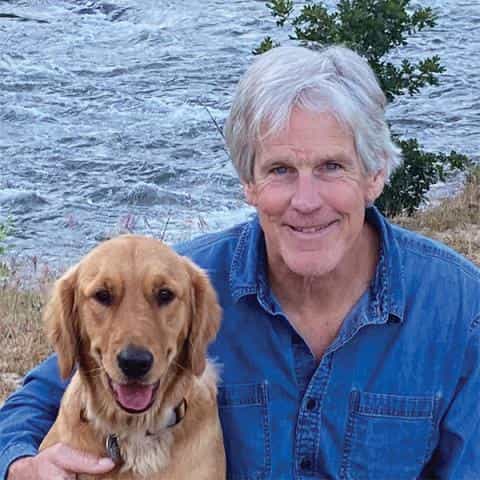
Stephen Kiesling is a founding editor of Spirituality & Health magazine and is now editor at large. A lifelong journalist, he was a Scholar of the House in philosophy at Yale University and an Olympic oarsman. His passion is building parks and playgrounds. His current project is a whitewater park and sculpture garden at Ti’lomikh Falls on the Rogue River in Oregon. Visit goldhillwhitewater.org.
More
 Article
The Six Ceremonies of Sustainability
A mix-up leads to a revelation about Indigenous ceremonies at Ti’lomikh Falls, uncovering the vital role of water blessings in sustainable living.
 Article
Bright Lights: Steven Nygren Builds Community, Connection, & Hope at Serenbe
Discover Serenbe, the walkable, nature-connected neighborhood outside Atlanta prioritizing health, sustainability, and meaningful relationships created by Steven Nygren.
 Article
Our Widely Distributed Intelligence
From MIT’s Cog and Kismet to a friendly robot at CES, discover how embodied intelligence challenges our notions of soul, consciousness, and human connection.
 Article
A Brain Surgeon’s Stairway to Heaven
Stephen Kiesling explores the life of Dr. Allan Hamilton, whose work bridges science, spirituality, and innovation in surgery and trauma healing.